
Manager Mentor
How consistent are you as a manager?

Welcome to the Third ManagerMentor newsletter where I answer the 50 Most Pressing Questions Facing Managers in 2026. These 50 Questions are a core component of the ManagerMentor learning and development system that I purpose-built for millennial and gen-z managers. Enjoy this free preview. Learn more here.
QUESTION #3: How consistent are you as a manager?
SUMMARY
Consistency is the number one reason millennials and gen-z recommend a manager — or don’t. My research identified six specific drivers of consistency that separate great managers from the rest. Today’s newsletter is about self-reflection: take a consistency scan of your team. Use the exercise to find out where to get better as a manager.
WHY: Here’s what’s changed
Millennials and gen-z know they can’t count on the corporate ladder the way their parents did.
They do not expect to spend their entire career in the same organization — that’s an idea boomers grew up with.
Instead, the best people today are already charting their own course — one chapter at a time, not one level at a time.
That’s why the #1 reason people leave a job today is a lack of opportunities for career growth.
This generation knows all they control is their story — and they’re looking for managers who can help them write it.
At its core, millennials and gen-z know a consistent manager increases the odds of being recognized and rewarded for exceeding expectations.
It makes sense when you think about it: in a world where so much is uncertain, consistency is the exact opposite.
WHAT: Consistency isn’t a personality trait; it’s a set of behaviors
Alignment — Every job role on your team must have a direct line of sight to your priorities, goals, and metrics — because that’s the only way your people can be recognized and rewarded for their work.
Accountability — The key to accountability is knowing who can make decisions — when employees can clearly see the buck stops with them, it inspires them to take risks and innovate because they know they control their destiny.
Mindset — Your people don’t have time to reverse-engineer your brain — they want to know how you’re wired as a decision-maker, because the way you think will directly influence who gets recognized and rewarded.
Process — The more your people know your team’s operating model, the less time they’ll spend wondering how you prioritize budgets and rewards — and the faster they’ll align behind your goals and focus on executing them.
Facts — A team can only have one, single scorecard of success — because facts truly empower people, giving them an extra step in confidence that their work has a foundation built on something real.
Listening — If something is keeping your people up at night, you need to know about it — because when you act on what you learn, it motivates your people to believe you have their back.
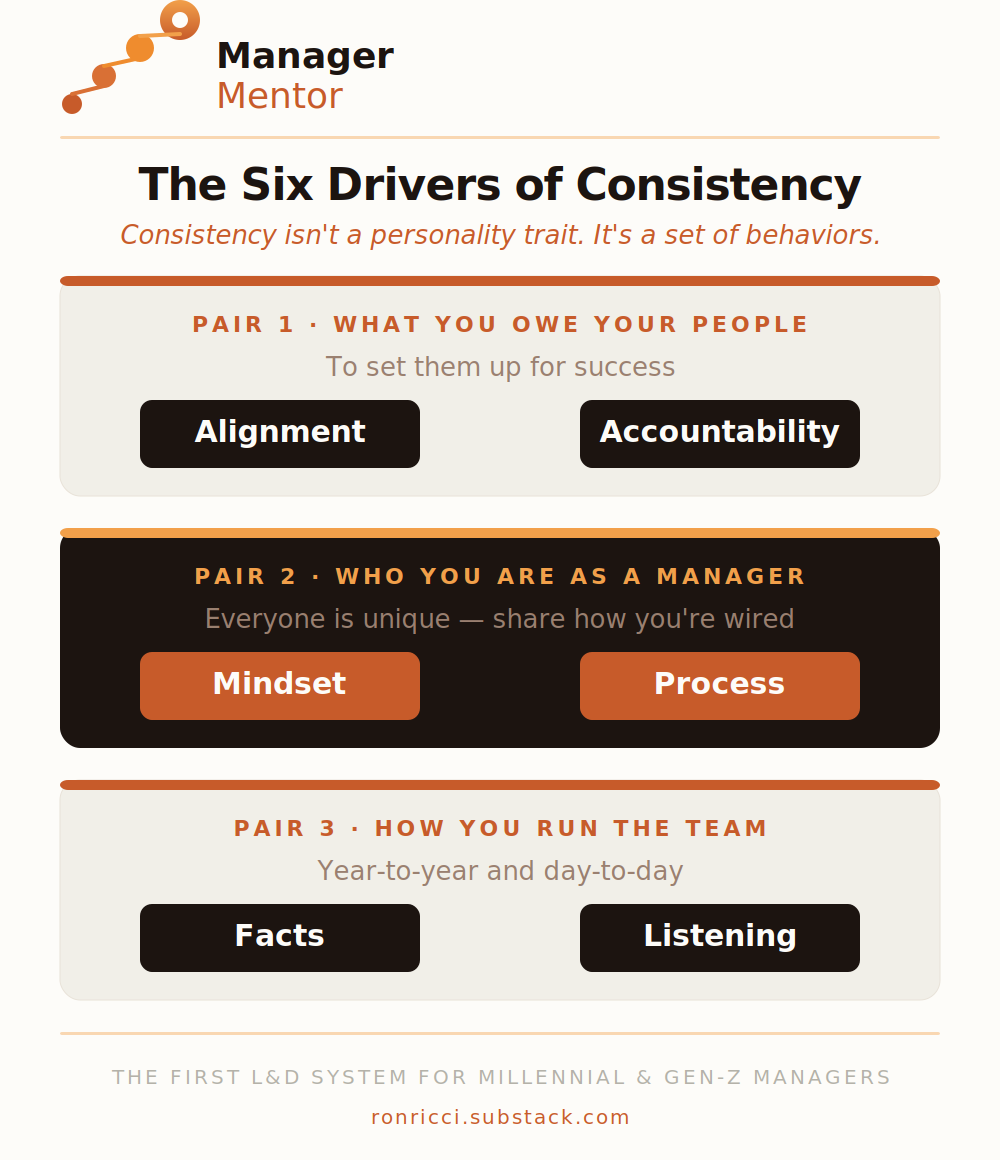
Think about the Six Drivers in three pairs — because that’s how they actually work together in the real world.
The first pair — Alignment and Accountability — is about what you owe your people to set them up for success. Alignment and accountability are bookends of a well-run team.
The second pair — Mindset and Process — is about who you are as a manager. This is the most personal part. It requires honesty and self-reflection.
The third pair — Facts and Listening — is about how your people experience you as a manager every day.
Think of it this way: the first pair builds the foundation. The second pair builds the manager. The third pair builds the way your people execute as a team.
HOW: Take a “Consistency Scan” of Your Team
For each of the Six Drivers, I’ve created practical toolkits that show you how to take action and develop yourself. Paid subscribers can access these toolkits and other resources in our L&D system.
But before you dive into the toolkits, start here:
The Consistency Scan is a one-question-per-driver exercise. Answer each question. Wherever you hesitate — that’s where you start.
1. Alignment
Publishing your priorities allows your people to clearly align their responsibilities to the reward system of your team.
Can everyone on your team connect their daily work to the priorities, goals, and metrics on your dashboard?
2. Accountability
The best people today want to own their work — but only you can set them up to do it. Knowing who makes decisions about budgets and rewards is the key to ending ambiguity and all the time it wastes.
Have you published the names of your decision-makers — and does your team know where the buck stops?
3. Mindset
Your people don’t want to waste time reverse-engineering your brain. The more you share about how you think and make decisions, the more trust and fairness you build on the team.
Does your team know your strengths and weaknesses as a decision-maker — and the steps you take when you have to make a tough choice?
4. Process
Process provides the consistent context your people need in order to see how their work aligns to your priorities — and stop wasting time wondering how things get done.
Can the people on your team describe how you set goals, allocate budgets, and evaluate performance?
5. Facts
Facts truly empower people — giving them an extra step in confidence that their work has a foundation built on something real. The best people want to be the standout player on your dashboard. And how goals are measured on that dashboard is the way your people will make their mark.
Does your team have one single scorecard of success — one source of truth everyone works from?
6. Listening
Nothing sends a clearer signal about a team’s commitment to career planning than your behavior. Your people are already talking among themselves. The question is whether you know what they’re saying.
Do you know what’s keeping your people up at night — and are you doing anything about it?
SEE WHERE YOU STAND
How consistent are you? Take the Self-assessment.
ManagerMentorAI • All Rights Reserved • The Culture Platform, Inc. • 2026