

Managing in the Age of Uncertainty
Remote work ruined development for Millennials and Gen-z

Meetings used to be where you could learn and grow.
I advise or sit on the boards of several software start-ups where I either manage or coach millennials and gen-z teammates. Each of the start-ups works in a virtual fashion — no actual offices.
While this approach works at the board-of-directors level, it doesn’t for young people. As Amber Moore told me previously in this newsletter, remote work robs millennials and gen-z of opportunities to learn through “osmosis” — by watching teams go through the process of making decisions about how to solve problems, in both the formal and informal ways work gets done.
For boomers, the human condition at work could be defined by the whiteboard and all the ideas scribbled on it — until a team of people agreed on a direction forward after a period of debate, disagreement and compromise. Knowing how to be a great member of a team accountable for things is what I’m talking about.
In this week’s issue of Managing in the Age of Uncertainty, I’m focusing on how we use our meeting time to include the “osmosis” of learning every time the group is together. In person or on video.
Clarity of Purpose Meeting Model
When I was at Cisco, one of my teammates was Julianne Whitelaw. She took on the idea of making meetings inside the company more productive. In my book The Collaboration Imperative, we featured a chapter on the meeting model Julianne invented called “Stop Wasting Time.”
I’m calling on managers to be more thoughtful about the way they use meetings to get stuff done operationally but to also better leverage meetings as a development platform for the next generation of talent.
Remember, most managers today only spend about 10 percent of their time developing people. Yet, managers spend between 35-50 percent of their day in meetings. Sometimes the simplest solutions are the best. Meetings and development have to become one.
So I’m updating the Clarity of Purpose meeting model to help managers better use meetings as a vehicle to develop people on the team. Think of yourself as a manager, how effective are your meetings? Where would you like to improve? How often are you a “teacher” in a meeting?
The Three Meeting Formats That Work
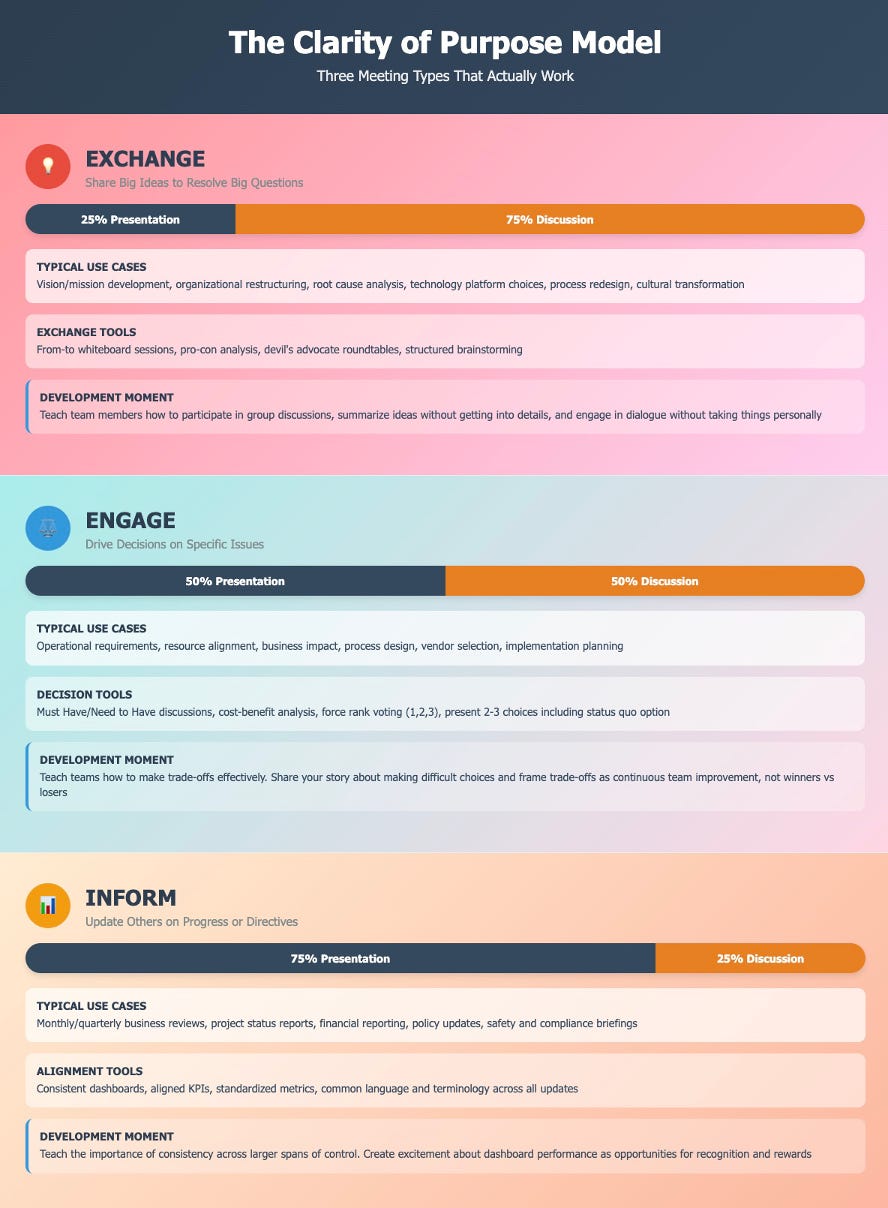
Every productive meeting falls into one of three categories, and each has unique opportunities to develop people on the team:
“Exchange” meeting where big ideas are shared and agreed upon.
“Engage” meeting where specific decisions are made.
“Inform” meeting where updates are communicated.
Exchange Meeting: Share Big Ideas to Resolve Big Questions
When to use: The team needs to agree on vision, future direction, or complex cross-functional goals. Exchange meetings are best used to brainstorm solutions when your team must resolve problems or come to agreement on open issues or strategy decisions.
Typical use cases: vision/mission development, organizational restructuring, root cause analysis, technology platform choices, process redesign, cultural transformation, among others.
Format: 25% presentation, 75% discussion.
The approach: The formal presentation time should communicate structure and parameters — to literally “exchange” ideas on a specific topic.
Different ways to exchange ideas include a “from-to” whiteboard session; a “pro-con” analysis or a “devil’s advocate” roundtable, among others.
Development moment: For managers, Exchange meetings are the ideal opportunity to teach people on the team how to participate in group discussion and direction-setting. The exchange exercises require everyone to participate but have the purpose of focusing the team on agreement. As a manager, this is a great to chance to teach people about how to summarize an idea when participating, rather than getting into the details of the “how. It’s also an amazing opportunity to teach people how to talk to each other without taking things personally. Using formal “idea exchange” models like “pro-con” de-personalize people’s perspectives.
Engage Meetings: Drive Decisions on Specific Issues
When to use: Engage meetings are best when a team needs more dialogue around specific strategies — and when a team needs to make choices about “how” to implement something.
Typical use cases: operational requirements, resource alignment, business impact, process design, vendor selection, among others.
Format: 50% presentation, 50% discussion.
The approach: The goal is to come into the meeting with 2-3 choices, rather than a single proposal, to drive group dialogue and agreement on which of the choices is best. It’s almost always best to make one of the choices a status quo choice — to ensure the other choices are new.
At this point, the choices are essentially trade-offs — your team can’t afford to fund everything and/or some choices are definitely more effective than others. An engage meeting needs tools to force choices. Use “Must Have/Need to Have” discussions or cost-benefit analysis; ask teams to “force rank vote” (1,2,3) on the choices, AND, be clear about who (you) has final decision-making authority.
Development moment: For managers, the Engage meeting is an opportunity to teach how teams make trade-offs — the most difficult job of managing a team. You are the team leader or manager because you are likely good at making choices. Share your story. Teach your teammates that trade-offs are not about choosing one idea over another — no winners and losers — but instead a choice about the likely effectiveness and efficiency of an idea relative to all the others. People never like making trade-offs, but the best managers know trade-offs are a way of continually improving a team.
Inform: Update Others on Progress or Directives
When to use: This type of meeting is best when the major decisions have already been made. Time in the meeting is devoted to updating key stakeholders on progress; it’s not a place for debate or challenging decisions already made.
Typical use cases: Monthly/quarterly business reviews, project status reports, financial reporting, policy, safety and compliance update.
Format: 75% presentation, 25% discussion
The approach: One the key themes of this newsletter is the importance of alignment — between and among priorities, goals and metrics and the job roles executing the work. Inform meetings should reflect this philosophy: it should be easy to give/receive updates because everyone already is aware of the alignment. Everyone should already know the KPIs, the performance metrics, the timeline, etc.
Development moment: For managers, the Inform meeting is a chance to teach the team about the importance of consistency. The average manager today manages 2X the number of direct reports compared to boomer managers. Consistency across such a large span of control starts and end with everyone speaking the same language. Language and metrics have to be aligned formally on some form of a dashboard. Keep in mind as a manager, you want your people to be excited about the work on your dashboard — your people will see it as an opportunity to be recognized and rewarded. Do you have a consistent dashboard that you use consistently?
Manager Thought of the Week
“The best managers are good at what I call the ‘CEO’s Conundrum’ — the choice between the present and the future.”
Ok. I’m quoting myself, but I really want to encourage managers to share their stories of decision-making. Every leader or manager made it to that level because of the quality of the decisions they’ve made. Share your story and approach. It’s a form of development for your people. You have natural strengths that make you a good decision-maker. Helping your team understand the way your brain is “wired” is helping in its own right. It’s even more helpful to ask your people to tell you their strengths.
In Summary: Principles of Managing in the Age of Uncertainty
I left Cisco to answer this question with research and evidence: What does the manager of the future look like? What are millennials and gen-z seeking in a manager? Which behaviors, tactics, skills or processes matter? What’s it going to take to attract and keep the best people over the next decade? In short, how to be a great manager.
Based on this research, the core philosophy of this newsletter is rooted in one idea: successful managers in this moment in time, for this generation of talent, need to be “career dot-connectors.” The next-gen doesn’t expect to spend their entire career on your team — that’s an idea boomers grew up with. A job on your team is like a chapter in a career story to the current generation. If you want the best people on your team, you have to connect the dots between roles on the team and the career opportunities of the people working on the team.
What is the“Age of Uncertainty”? If the industrial age was about taking predictable steps up the ladder, the age of uncertainty is about finding or discovering the path of a career without any predictable steps, without an obvious ladder — it’s why being a career dot-connector will differentiate you as a manager.
How to be a Great Manager in the Age of Uncertainty: Be a Career Dot Connector is available on Amazon.
What kind of manager are you? Take my free self-assessment and learn about yourself.
This is so helpful, Ron. Thanks for providing such great formats for meetings.
Such practical advice. I agree -- time in meetings could be better spent for coaching and skill building. Most of my early development came via "OJT" with great managers and mentors like you :-)